BTTInferGrid is a decentralized GPU computing network purpose-built for AI inference. By bridging the global supply of idle GPU capacity with the surging demand for AI workloads, BTTInferGrid delivers an open-access, verifiably secure, and pay-as-you-go computing infrastructure for AI developers worldwide.
SINGAPORE, June 17, 2026 (GLOBE NEWSWIRE) -- On June 17, BitTorrent, a pioneer in decentralized technology, announced the strategic launch of BTTInferGrid to capture the rapidly growing AI inference market. Utilizing a decentralized, edge-computing architecture, the platform aggregates fragmented, underutilized GPU resources globally. By eliminating friction between hardware providers and AI developers, BTTInferGrid offers a highly scalable inference engine featuring plug-and-play access, on-chain verification of computation results, and flexible utility-based billing.
By leveraging decentralized orchestration, BTTInferGrid solves the inherent bottlenecks of traditional centralized cloud providers, such as high-concurrency latency and rigid pricing models during demand spikes. On the supply side, the network redefines the economics of idle hardware, optimizing resource allocation across the entire computing ecosystem.
This launch marks a strategic expansion of BitTorrent's utility beyond its core BitTorrent File System (BTFS) storage protocol. By combining its proven expertise in large-scale decentralized resource scheduling with high-performance computing, BitTorrent is positioning itself as a foundational infrastructure layer for the decentralized AI era.
From Training to Inference: BTTInferGrid Reengineers the AI Compute Supply Chain
The structural demand for AI compute is undergoing a fundamental shift from training to inference. BTTInferGrid is launching at this critical juncture to transform the supply side through its decentralized infrastructure, addressing prohibitive costs and resource bottlenecks to deliver cost-effective, high-performance compute.
Industry consensus projects that over 70% of future AI compute workloads will be dedicated to inference—the critical phase where AI models transition from development to production-grade deployment. While training is a one-time capital expense, inference is a continuous operational cost that directly impacts user experience and business viability. Oracle forecasts that the inference market will ultimately dwarf training in scale. Academician Zheng Weimin also notes that the vast majority of computing power is now consumed during daily user interactions with large models. This is reflected in operational budgets: inference now accounts for up to 95% of LLM compute expenses. Daily costs reach $700,000 for legacy platforms like ChatGPT, while even optimized models like DeepSeek V3 incur $87,000 daily.
As AI development democratizes, expanding beyond tech giants to millions of independent developers, traditional centralized infrastructure is failing on three fronts:
1. Inflexible Allocation vs. Volatile Workloads: Inference demand is inherently spiky, with peak-to-trough utilization ratios fluctuating by orders of magnitude within a single day. Centralized data centers force operators into a costly dilemma: over-provision hardware to guarantee peak availability—resulting in expensive idle capacity—or under-provision and risk service degradation. This systemic inefficiency, compounded by massive data center overheads like power and maintenance, keeps rental costs artificially high.
2. Prohibitive GPU Pricing Hinders Innovation: Despite the surge in open-source models, practical deployment remains constrained by the cost of stable, accessible hardware. Rather than scaling down, GPU access costs have surged. On specialized clouds, secondary market rates for mainstream H100 GPUs rose from $1.70/hour in October 2025 to $2.35/hour in March 2026—a nearly 40% spike that leaves developers with sophisticated models but no viable compute to run them.
3. Supply-Demand Mismatch and Isolated Compute Pools: A massive volume of GPU capacity sits idle within private networks, academic labs, and regional data centers worldwide. Due to the lack of standardized access and unified orchestration, these scattered resources remain locked out of the global inference market. This creates a market paradox: developers face chronic hardware shortages while vast reserves of computing power sit dormant.
In summary, the AI inference market is trapped in a triple squeeze: rigid centralized architectures lack elasticity, skyrocketing GPU rental fees stifle innovation, and fragmented global compute remains stranded. To break this deadlock, BTTInferGrid leverages decentralized technology to offer a new solution.
Specifically, the platform dismantles centralized monopolies and infrastructure bottlenecks by establishing a direct, decentralized corridor between global developers and idle GPU resources. First, BTTInferGrid aggregates fragmented, underutilized hardware into a highly unified and open-access computing commons. Second, it bypasses legacy intermediaries to eliminate artificial entry barriers and opaque pricing, facilitating a frictionless transaction environment. Driven by robust DePIN incentives and coordination protocols, the network guarantees continuous access to high-performance, cost-effective inference capacity, neutralizing stifling financial barriers and supply constraints at the source.
BTTInferGrid: Redefining Computing Power Allocation with a Decentralized Network for AI Inference
BTTInferGrid is architected with a singular mission: to establish the definitive decentralized infrastructure for AI inference. By bridging the global divide between idle GPU supply and escalating inference demand, the platform provides a permissionless gateway to high-performance compute that pairs verifiable execution with a flexible, pay-as-you-go model.
Leveraging a robust DePIN architecture, BTTInferGrid empowers both sides of the AI computing marketplace:
- On the supply side, it aggregates fragmented, idle GPUs to build an open, shared computing foundation. Powered by tokenized incentives and intelligent routing, the network enables resource providers to seamlessly monetize their idle hardware—transforming it into yield-generating assets while ensuring a stable, scalable supply of compute.
- On the demand side, it equips global AI developers with accessible, on-chain verified, and on-demand inference services. Compared to traditional centralized cloud providers, BTTInferGrid delivers a highly cost-efficient and scalable alternative. This significantly lowers the barrier to entry for small and medium-sized teams, accelerating product development cycles while funneling value back into the supply-side ecosystem.
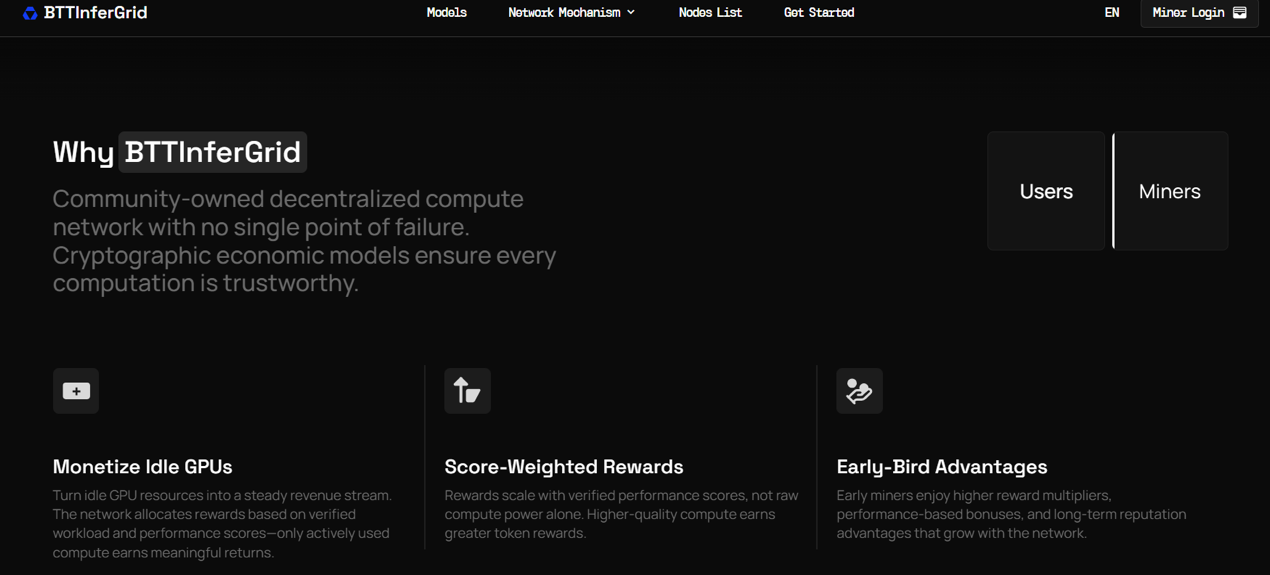
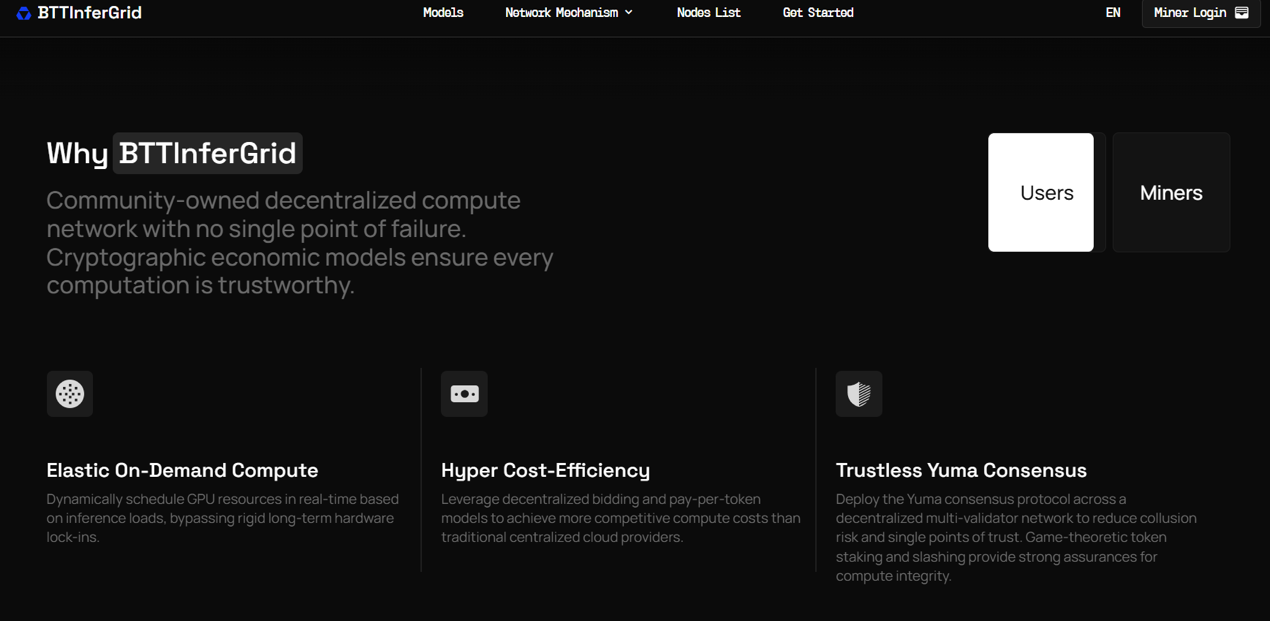
BTTInferGrid is driving a powerful, self-sustaining growth flywheel: an expanding network of idle GPU nodes drives down computing costs, which in turn accelerates developer adoption. This surging demand further incentivizes new hardware suppliers to join the ecosystem, ultimately transforming scarce, high-cost AI computing power into an inclusive, on-demand decentralized infrastructure.
While most decentralized GPU platforms are currently hindered by prohibitive barriers to entry, opaque service reliability, and unsustainable business models, BTTInferGrid is engineered from the ground up to deliver three strategic breakthroughs, establishing a clear competitive edge:
1. Permissionless Access and Rapid GPU Aggregation: Any individual or organization possessing idle GPUs that meet baseline performance and reliability standards can seamlessly connect to the network. This friction-free approach drastically lowers supply-side barriers to entry, rapidly consolidating distributed global compute into a unified network.
2. Verifiable Service Quality and Trustless Execution: To overcome trust deficit inherent in distributed networks, BTTInferGrid leverages advanced blockchain architecture to cross-validate all participant behavior. By integrating intelligent task routing, cryptographic spot checks, dynamic reputation scoring, and smart contract-based incentive and slashing mechanisms, the network effectively neutralizes fraud risks and ensures that all AI inference outputs are reliable, tamper-proof, and highly verifiable.
3. Demand-Driven Economics for a Sustainable Ecosystem: BTTInferGrid is anchored by authentic AI inference demand and performance-based node incentives. Rather than relying solely on inflationary token emissions, compute suppliers generate real yield directly from developers paying for active network utilization. This utility-first mechanism mitigates speculative farming, ensuring the robust, long-term viability of the ecosystem.
The strategic breakthroughs achieved by BTTInferGrid—dismantling traditional barriers to entry, mobilizing global idle GPUs into a borderless computing grid, and engineering an end-to-end trustless verification loop—are fundamentally redefining the decentralized compute landscape. By anchoring its tokenomics strictly to authentic AI demand, the network pioneers a new standard for how computing resources are aggregated, verified, and equitably monetized.
The BTTInferGrid Roadmap: Scaling on Real-World Demand
BTTInferGrid is more than a hardware aggregator; it is a full-stack decentralized compute protocol that seamlessly integrates intelligent task routing, dynamic supply-and-demand matching, and automated on-chain settlements.
The ecosystem is powered by the synergy of three core participants. Compute Providers (Miners) provision their idle GPUs to the network in exchange for tokenized rewards; Compute Requesters (AI Developers) access scalable computing power via unified APIs; and Validators verify service quality and enforce consensus to maintain network integrity. This tri-party architecture delivers cost-efficient, reliable AI inference for developers while generating sustainable, utility-backed yield for hardware providers.
BTTInferGrid follows a clear, robust, demand-driven phased launch strategy. Rejecting the industry trend of unsustainable, brute-force expansion, the network prioritizes optimal resource utilization, economic viability, and the systematic scaling of its technical architecture.
- Phase 1: Network Bootstrapping (2026)Onboard core nodes and validate distributed inference services. The primary objective is to scale the GPU node network and successfully navigate the cold-start phase.
- Phase 2: Ecosystem Diversification (2027)Strengthen network stability and privacy while expanding support for diverse AI model architectures. During this phase, the protocol will broaden its utility to accommodate complex scenarios, including decentralized model fine-tuning.
- Phase 3: Foundational AI Infrastructure (2028 and beyond)Establish BTTInferGrid as a native Web3 infrastructure layer, providing scalable compute for large-scale AI applications. The ultimate vision is the seamless convergence of decentralized compute, storage, and smart contracts into a unified ecosystem.
At launch, the network will prioritize professional-grade GPUs. To ensure initial stability, supply-side onboarding (miners) will initially be a permissioned process, while developers will retain seamless, on-demand access to inference services. BTTInferGrid will subsequently evolve into a fully permissionless supercomputing grid, supporting consumer, professional, and data-center-grade GPUs through a performance-based tiered pricing model. Node operators will benefit from open access secured by a staking mechanism to guarantee Service Level Agreements (SLA). Simultaneously, developers will gain access to unified APIs compatible with major model formats and inference frameworks, ensuring maximum deployment flexibility.
Crucially, BTTInferGrid is built on the battle-tested foundation of BitTorrent and the BitTorrent File System (BTFS). Having operated at a global scale, BTFS has already validated the DePIN model, demonstrating mature capabilities in hardware orchestration, tokenomic incentives, on-chain settlements, and decentralized governance. As the flagship initiative for BitTorrent’s expansion into Web3 AI, BTTInferGrid represents an evolutionary upgrade of the BTFS ecosystem. By migrating these proven operational frameworks into the AI inference domain, BTTInferGrid leverages a significant structural advantage to drive rapid, sustainable growth.
Media Contact:
BitTorrent Team
bttc_support@bittorrent.com
Disclaimer: This sponsored content is provided by the content provider and does not necessarily reflect the views of this media platform or its publisher. The information is shared for general informational purposes only and should not be considered financial, investment, or trading advice. Cryptocurrency and mining-related activities carry risks, including the potential loss of capital, and readers are encouraged to conduct their own research and seek professional advice where appropriate. Speculate only with funds that you can afford to lose. The media platform and publisher assume no responsibility for any losses or claims arising from reliance on this content. GlobeNewswire does not endorse any content on this page.
Legal Disclaimer: This article is provided on an “as-is” basis, without warranties or representations of any kind, express or implied. The media platform assumes no responsibility or liability for the accuracy, content, completeness, legality, or reliability of the information presented. Any complaints, claims, or copyright concerns related to this article should be directed to the content provider mentioned above.
Photos accompanying this announcement are available at:
https://www.globenewswire.com/NewsRoom/AttachmentNg/09ab6648-d83b-46f3-94c0-13a29ef12639
https://www.globenewswire.com/NewsRoom/AttachmentNg/534107d8-3b95-4734-a53e-af0d3c9c61a9
https://www.globenewswire.com/NewsRoom/AttachmentNg/63425133-b4a7-450e-a8b3-bc705fd8926f
https://www.globenewswire.com/NewsRoom/AttachmentNg/3f31a333-59f0-444d-b950-7e711ae69be7

