
Porsche Taycan Collision Repair: High-Voltage Safety Standards for Winter Garden's Electric Sports Cars
Winter Garden, United States - March 5, 2026 / Windermere Collision Center /
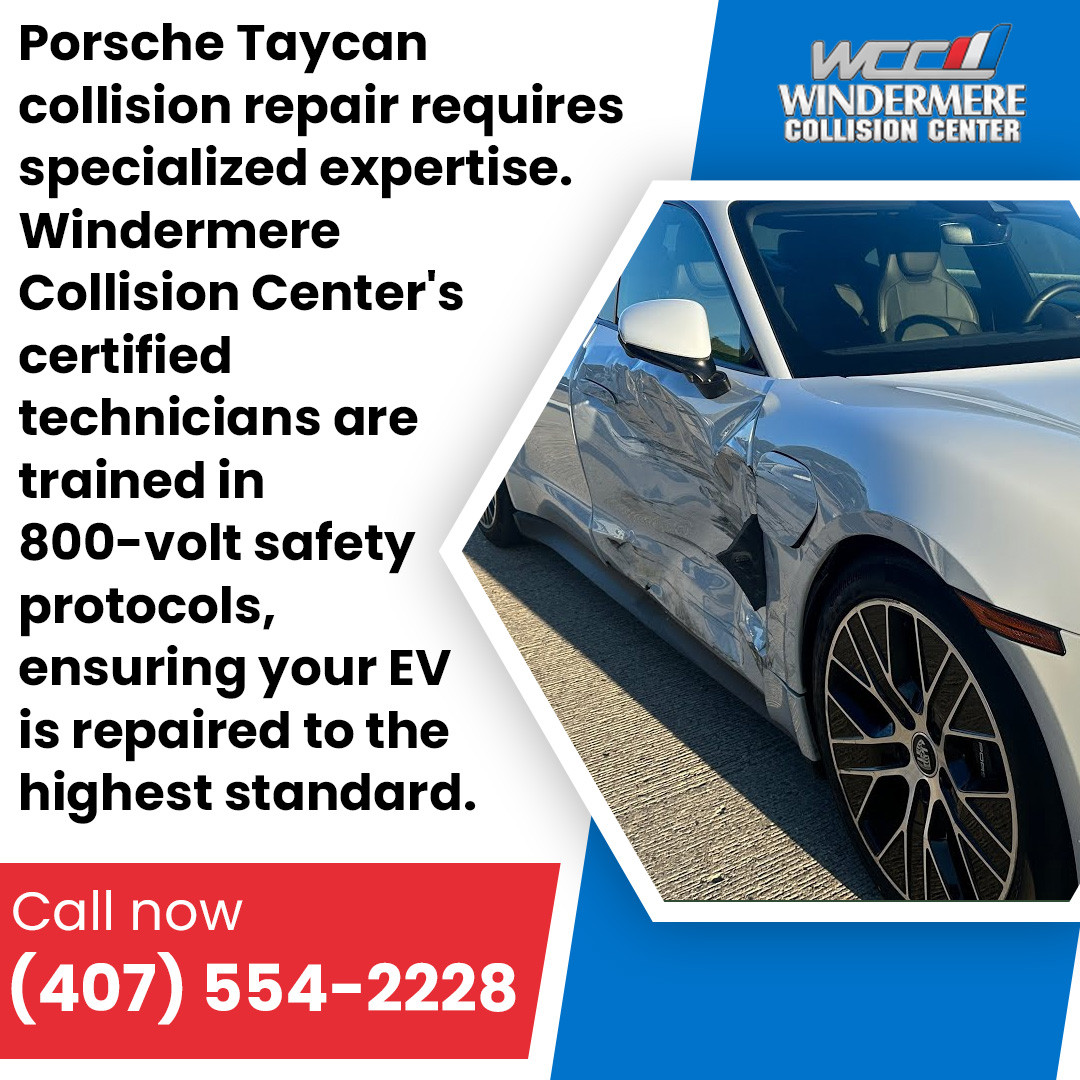
Winter Garden, FL – The emergence of high-voltage electric sports cars creates unprecedented collision repair challenges that extend far beyond traditional automotive bodywork. Porsche's Taycan operates on an 800-volt architecture that nearly doubles the electrical system complexity found in conventional electric vehicles, requiring collision repair facilities to maintain manufacturer-specific certifications, specialized diagnostic equipment, and rigorous safety protocols that protect both technicians and vehicle integrity.
Winter Garden drivers seeking qualified Porsche Taycan collision repair services face critical decisions about facility selection. Windermere Collision Center provides manufacturer-certified repair services for Porsche electric vehicles at a 40,000 square foot facility equipped with Porsche-approved diagnostic systems and staffed by technicians holding high-voltage system certifications.

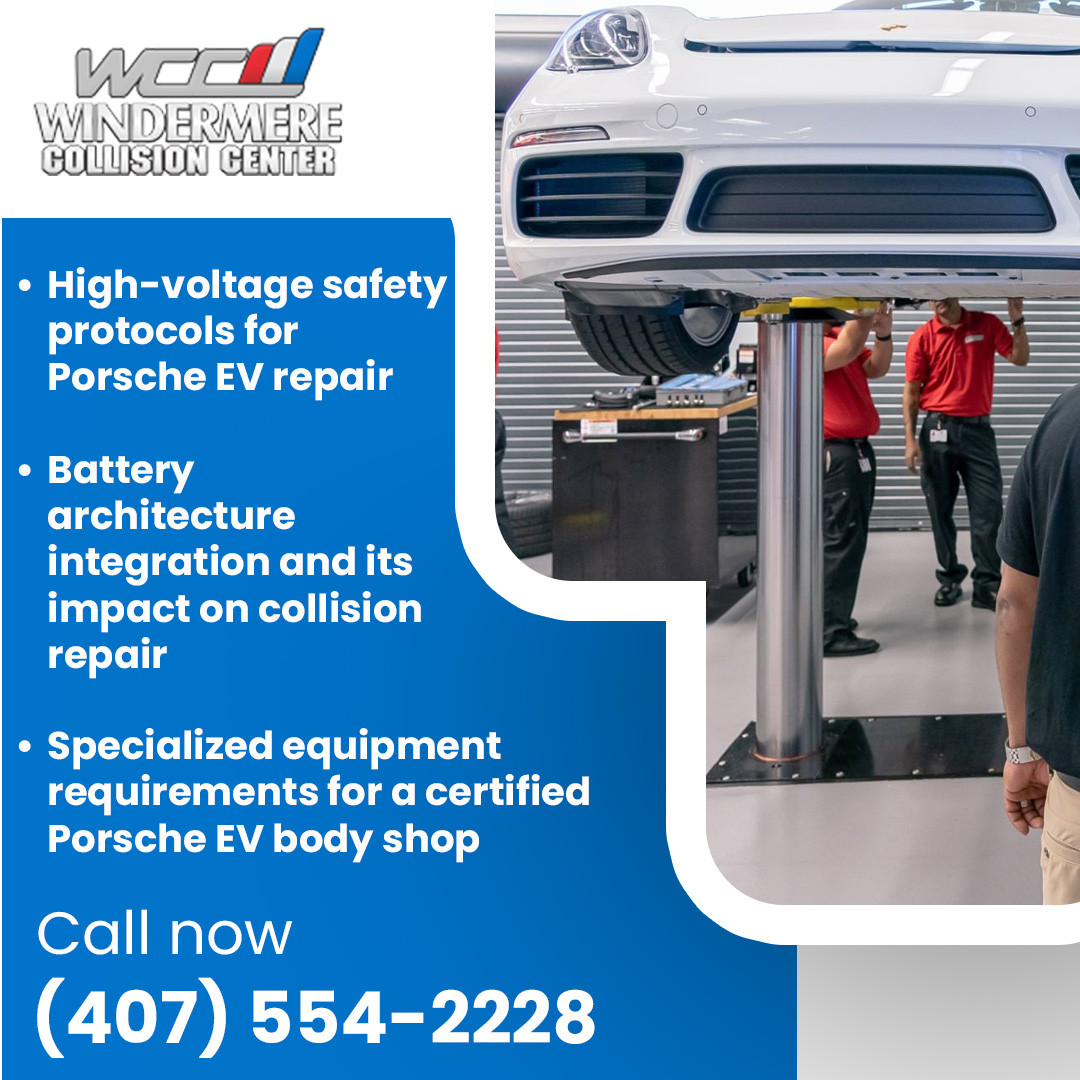
High-Voltage Safety Protocols for Porsche Electric Vehicle Repair
The Taycan's electrical architecture operates at voltage levels that create severe safety hazards during repair work. Unlike 400-volt systems common in other electric vehicles, the 800-volt platform delivers faster charging capabilities while simultaneously increasing arc flash risks that can cause fatal injuries without proper safety measures.
Mandatory safety protocols for Porsche electric vehicle repair include:
Safety Protocol | Requirement | Purpose |
Battery Disconnect | Complete high-voltage isolation within 5 minutes | Eliminates electrical shock hazards |
Personal Protective Equipment | Class 0 insulated gloves rated to 1000V DC, face shields, insulated footwear | Protects against arc flash and electrical contact |
Waiting Period | 5-10 minute discharge time after disconnect | Allows capacitors to fully discharge |
Voltage Verification | Multimeter confirmation showing 0-10 volts | Confirms system safety before physical work |
Insulated Tools | All tools rated for 1000V DC | Prevents accidental circuit completion |
Technicians working on these systems complete manufacturer-specific training covering the electrical architecture unique to Porsche's 800-volt platform. According to research on battery safety protocols for high-voltage electric vehicles, proper disconnect procedures must account for challenges posed by 800-volt systems where arc flash risks increase proportionally with voltage.
Battery Architecture Integration Affects EV Collision Repair Methods
The Taycan's battery pack integrates directly into the vehicle's structural framework, serving both as energy storage and a load-bearing component that helps dissipate crash forces. This structural integration creates unique EV collision repair challenges because battery housings form part of the crash structure designed to absorb impact forces.
Damage assessment requires specialized diagnostic equipment capable of communicating with Porsche's battery management system. Research on handling EVs after collision incidents indicates that high-voltage battery assessments must include resistance testing of underbody cables, thermal imaging to detect hotspots, and comprehensive diagnostic scans using manufacturer-specific software.
Critical assessment components include:
Internal cell damage evaluation that may not trigger warning lights
Cooling system integrity verification
Insulation breach detection
Protective structure analysis for welding heat exposure
Battery management software validation
Specialized Equipment Requirements for Certified Porsche EV Body Shop Facilities
Porsche maintains strict equipment standards for facilities authorized to perform Taycan repairs. The PIWIS diagnostic system provides the only approved method for communicating with the Taycan's multiple control modules, accessing vehicle-specific repair procedures, wiring diagrams, and calibration sequences that generic scan tools cannot replicate.
Equipment requirements for a qualified Porsche EV body shop extend across multiple categories:
Insulated hand tools rated for 1000V DC
High-voltage meters for confirming system isolation
Porsche-approved welding equipment for aluminum repairs
ADAS calibration targets designed specifically for Porsche systems
Climate-controlled paint environments meeting manufacturer specifications
Battery handling equipment capable of safely supporting high-voltage assemblies
Windermere Collision Center maintains climate-controlled paint environments using Italian Symach equipment designed for manufacturer-certified repairs of luxury vehicles, ensuring precise temperature and humidity control throughout the painting process.
Factory Certification Standards and Technician Training
Porsche's Approved Collision Center designation requires facilities to demonstrate competency across technician training, equipment standards, and ongoing quality verification. According to I-CAR's Porsche training requirements documentation, Porsche requires facilities to maintain technicians with specific certifications:
I-CAR Platinum Recognition for collision repair fundamentals
Porsche-specific technical training covering brand-unique construction
High-voltage electrical training for EV and hybrid models
Aluminum welding certification for lightweight materials
ADAS calibration training for advanced driver assistance systems
Annual training requirements typically include 40 hours of hands-on instruction at Porsche training facilities covering new model introductions, updated safety procedures, and advanced repair techniques. Windermere Collision Center technician teams include specialists trained on 800-volt architectures and advanced aluminum construction techniques specific to modern electric sports cars.
Post-Repair Testing Validates Collision Repair for Electric Vehicles’ Safety Systems
Post-repair validation on collision repair for electric vehicles requires comprehensive testing beyond traditional vehicle inspection. High-voltage system integrity testing confirms voltage isolation, battery management function, cooling system performance, charging capability, and power delivery response.
ADAS recalibration represents one of the most technically demanding procedures. Modern collision repair industry research on EV challenges demonstrates that cameras misaligned by just 0.6 degrees can reduce automatic emergency braking reaction time by 60 percent.
Taycan ADAS components requiring calibration after collision repair include:
Forward-facing cameras for lane keeping assistance
Radar sensors for adaptive cruise control
Ultrasonic sensors for parking assistance
Side-mounted radar for blind spot monitoring
Surround-view cameras for 360-degree visibility
Windermere Collision Center utilizes Porsche-approved ADAS calibration equipment and PIWIS diagnostic systems to verify that all vehicle systems operate within normal parameters before final delivery.

Schedule Your Certified Porsche Assessment Today
Selecting an uncertified facility for Taycan repairs creates substantial risks, including improperly executed high-voltage work, compromised battery crash protection, and malfunctioning safety systems. These risks affect warranty coverage, resale value, and insurance claim validity.
Winter Garden area drivers can schedule transparent assessments with Windermere Collision Center by calling (407) 554-2228 or visiting the facility's contact page to connect directly with certified technicians who deliver repairs meeting Porsche's exacting standards for “auto collision near me” searches.

Contact Information:
Windermere Collision Center
933 Carter Rd
Winter Garden, FL 34787
United States
Tom Ramsammy
(407) 554-2228
https://windermerecollisioncenter.com/


Original Source: https://windermerecollisioncenter.com/porsche-taycan-collision-repair-high-voltage-safety-standards-for-winter-gardens-electric-sports-cars/
