Get Your Kicks With Route 66 Stamps
PR Newswire
PHOENIX, May 5, 2026
PHOENIX, May 5, 2026 /PRNewswire/ -- The Postal Service today commemorated the centennial of Route 66 with the release of a set of eight stamps, each showing a site from the states through which the roadway runs.
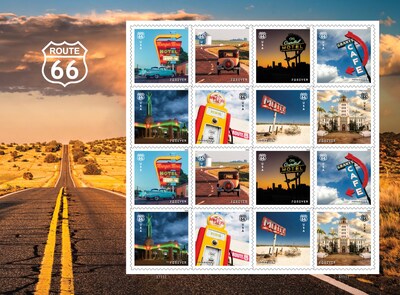
The selvage features a photograph of the historical highway stretching into the distance in Arizona, capturing the sense of possibility the open road inspires. The first-day-of-issue ceremony was held in Phoenix at the National Postal Forum, the mailing and shipping industry's premier trade show.
For a century, drivers have hit the open road chasing the American Dream along Route 66, which originally stretched about 2,400 miles from Chicago to Los Angeles. Route 66 forever changed how Americans travel and became a symbol of freedom and adventure. These stamps from the U.S. Postal Service celebrate the 100th anniversary of the iconic road, honoring its enduring spirit and the ongoing efforts to preserve this uniquely American treasure.
"The men and women of the Postal Service are proud to commemorate Route 66 and celebrate its shared purpose of binding the nation together," said Jeff Adams, the Postal Service's vice president of Corporate Communications, who dedicated the stamps.
"The Postal Service and Route 66 both played historical roles in our nation's expansion, as conduits for goods and communication — moving hundreds of thousands of letters and packages for Americans as they journeyed westward. These stamps feature many sights that travelers or transport drivers would have seen in the 'Mother Road's' heyday… sights that have become popular stops for tourists today." he said. Adams was joined in dedicating the stamps by Rod Reid, chairman of the United States Route 66 Centennial Commission.
"The Route 66 stamp issuance represents an open invitation to come experience Route 66 for yourself along with the many historic and iconic landmarks you'll see along the way," Reid said.
The stamps' photographer, David J. Schwartz, also spoke at the ceremony.
"Route 66 isn't history behind glass or a velvet rope. It's living history that people can still step into and become part of. Seeing these photographs travel across the country on U.S. postage stamps is incredibly meaningful to me, because it brings the spirit of the 'Mother Road' into millions of homes and hopefully inspires people to experience the road and support the small businesses that keep its story alive," he said.
When the route was first mapped, it stitched together a patchwork of existing, mostly unpaved roads to form a continuous 2,448-mile highway passing through eight states: Illinois, Missouri, Kansas, Oklahoma, Texas, New Mexico, Arizona and California. Its eastern terminus was at the intersection of Michigan Avenue and Jackson Boulevard in Chicago, and the western terminus was at Broadway and Seventh Street in Los Angeles. Rather than follow a linear course, Route 66 meandered across the country, connecting small rural communities that might otherwise have been bypassed. The Chicago-to-Los Angeles route was designated Route 66 on Nov. 11, 1926.
Route 66 was a lifeline for people seeking better opportunities during the Great Depression in the 1930s and earned the nickname "The Main Street of America." The highway also transformed the U.S. trucking industry by offering an alternative to rail shipping, and during World War II, it carried job seekers westward to defense plants as military bases were established along the route.
After the war, Route 66 became a symbol of postwar optimism — an image of the freedom of the open road and the adventure of the West. With newfound prosperity and a car in the driveway, families explored the country and often relocated in the West, especially soldiers who had trained there during the war. The soundtrack of this "golden age" was Bobby Troup's hit song "(Get Your Kicks on) Route 66," recorded by Nat King Cole in 1946.
As automobile travel boomed, however, the need for larger highways grew. The Federal-Aid Highway Act of 1956, signed into law by President Dwight D. Eisenhower, funded the construction of a new interstate highway system. Over time, Route 66 was gradually replaced by Interstates 55, 44, 40, 15 and 10, which parallelled or were built over much of the original route. By 1984, the last section of Route 66 was bypassed, and the road was officially decommissioned in 1985.
Yet Route 66 refused to fade away. A resurgence of interest in the 1960s was further romanticized by the television show "Route 66," which ran from 1960 to 1964 and followed two adventurers driving the highway in a Chevrolet Corvette. Iconic roadside attractions continued to be built, including the 20-foot-tall Blue Whale in Catoosa, OK, created in 1970 by Hugh Davis as an anniversary gift for his wife, and Cadillac Ranch in Amarillo, TX, where 10 Cadillacs were buried nose-first in 1974. Both remain popular tourist destinations.
Even today, Route 66 continues to capture the imagination. About 85 percent of the original route is drivable, and around 250 buildings, bridges, road alignments and sites along the highway are listed on the National Register of Historic Places. Private and public organizations have stepped in to preserve stretches of the road and the small towns that thrived along it. State associations work to maintain the road's legacy, while federal initiatives such as the Route 66 Corridor Preservation Program ensure that the wonders of the past remain accessible to future generations.
In 2006, Pixar's animated film "Cars" introduced Route 66 to a new audience, with many scenes inspired by real-life landmarks along the historic highway. Although Route 66 has changed over the decades, it continues to unite the country with its call for adventure and the promise of freedom on the open road.
Greg Breeding, an art director for USPS, designed the stamps and stamp pane with existing photographs by David Schwartz.
The Route 66 stamps are issued in a pane of 16. As Forever stamps, they will always be equal in value to the current First-Class Mail 1-ounce price. News of the Route 66 stamps is being shared with the hashtag #Route66Stamps.
Postal Products
Customers may purchase stamps and other philatelic products through The Postal Store at usps.com/shopstamps, by calling 844-737-7826, by mail through USA Philatelic, or at Post Office locations nationwide. For officially licensed stamp products, shop the USPS Officially Licensed Collection on Amazon. Additional information on stamps, first-day-of-issue ceremonies and stamp-inspired products can be found at stampsforever.com.
Please Note: The United States Postal Service is an independent federal establishment, mandated to be self-financing and to serve every American community through the affordable, reliable and secure delivery of mail and packages to more than 170 million addresses six and often seven days a week. Overseen by a bipartisan Board of Governors, the Postal Service is celebrating its 250th year of service to customers amidst a network modernization plan aimed at restoring long-term financial sustainability, improving service, and maintaining the organization as one of America's most valued and trusted brands.
The Postal Service generally receives no tax dollars for operating expenses and relies on the sale of postage, products and services to fund its operations.
For USPS media resources, including broadcast-quality video and audio and photo stills, visit the USPS Newsroom. Follow us on X, formerly known as Twitter; Facebook; Instagram; Pinterest; Threads; and LinkedIn. Subscribe to the USPS YouTube Channel. For more information about the Postal Service, visit usps.com and facts.usps.com.
National contact: James McKean
jim.mckean@usps.gov
usps.com/news
Local contact: Sherry Patterson
sherry.l.patterson@usps.gov
usps.com/news

 View original content to download multimedia:https://www.prnewswire.com/news-releases/get-your-kicks-with-route-66-stamps-302761798.html
SOURCE U.S. Postal Service

