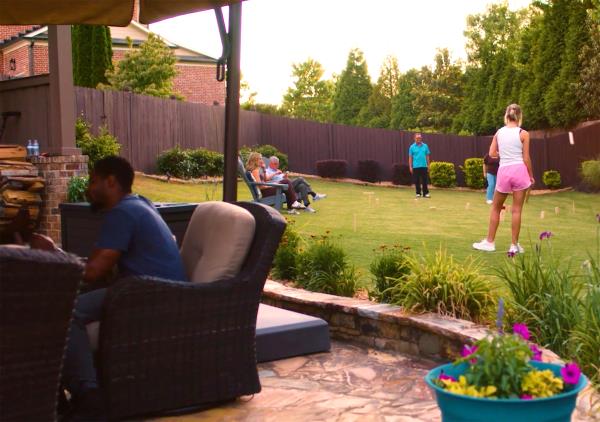
SPONSORED CONTENT -- (StatePoint) What distinguishes a good backyard gathering from a great one? More often than not, a little friendly competition.
Exmark has partnered with landscape designer, Doug Scott with Redeem Your Ground, on a new video that helps you break down the most common considerations for building a versatile backyard game space suitable for everything from cornhole to bocce to Kubb.
Location
“Location makes or breaks everything else. Get it right, and your space invites people in without saying a word. Get it wrong, and it becomes just another stretch of grass,” says Scott.
A good game space will be ideally sized, on flat ground, and receive shade during peak afternoon playing hours. Kubb, for example, only requires a 16 by 26-foot footprint, making it one of the most space-efficient options out there. If you want room for larger games like cornhole or football, aim for a 40 by 60-foot area.
Your space should feel like a natural extension of where people naturally congregate. Situate it close enough to the house that nobody’s making long treks for bathroom breaks—but far enough that a late-night game doesn’t carry into any bedrooms. Also, watch for overhead utility lines, exposed tree roots, and fences that could cut the fun short.
Seating
Giving spectators comfortable seating keeps the energy going between rounds. Options to consider include:
• A cluster of adirondack chairs with a side table gives you a movable conversation spot that adapts to wherever guests want to settle. Orient them so the sun is behind spectators during prime playing hours.
• For a more permanent setup, a simple L- or U-shaped built-in bench along the perimeter is hard to beat. It frames the space, and can be topped with cushions.
• A picnic table pulls triple duty, offering seating, a surface for food and drinks, and a natural gathering point between games.
• A fire pit just outside the perimeter is the perfect pre- and post-game hangout that extends your space’s usability into cool-weather season.
Storage
Accessibility is key. If equipment is stuffed in a bag under the porch, games won’t happen spontaneously. But when everything is right there? Game on! Whether you use a storage bench, a custom-built bin locker or shelving in your shed, the common thread should be proximity.
Lighting
Good lighting separates a space that’s useless after sundown from one that keeps the energy going all night. Just be sure to keep the light warm and out of players’ eyes. A simple layered approach works great:
• Warm string lights overhead at 10 feet or higher
• Solar lanterns around the perimeter to define the space
• A lit path connecting the game area back to the main patio. It’s a safety feature and says, “something’s happening over there.”
Landscaping
Landscaping transforms any patch of grass into an actual outdoor room. Here’s what to include:
• Low shrubs or ornamental grasses along the sides, well outside the playing area. They define the space, add a little privacy, and frame the action without blocking sightlines.
• Edging and borders. Natural stone, timber borders, pavers, or bricks give the court a clean, defined edge that tells everyone exactly where the play space begins and ends. It’s a small detail with a big visual payoff.
• Shade trees. Planting a tree at the southwest corner is a long-term investment worth considering.
• Rain garden or dry creek bed. Both are functional, attractive, and help keep the play surface from becoming muddy and washed out after a heavy rain.
Remember to avoid mulch adjacent to the playing surface, which migrates, and thorny shrubs. You don’t want a ball—or guest—rolling into a rose bush.
For more insights, watch the Done-In-A-Weekend Projects episode “How to Create a Dedicated Backyard Game Space” on Backyard Life, a unique multimedia destination with a focus on helping homeowners improve their outdoor living spaces. There you can also find the full rules of the Scandinavian lawn game Kubb, DIY instructions for building specific game spaces, and Exmark Original Series videos that make it easy to make meaningful improvements to your outdoor living experience.
“Remember, the best backyard game spaces are dialed in over a few seasons, as you get a feel for how you actually use the space,” says Scott. “Each addition makes the space more inviting, more functional, and more yours.”
