Interlune Produces Pure Helium-3 from Domestic Helium Using Novel Cryogenic Technology
PR Newswire
SEATTLE, July 20, 2026
Developed with Support from the U.S. Air Force, Cold Capture™ Addresses Immediate Demand for Helium-3 While Validating Core Technology for Harvesting on the Moon
SEATTLE, July 20, 2026 /PRNewswire/ -- Interlune, a space infrastructure and resources company, today announced that its Cold Capture technology has demonstrated production of 99% pure helium-3 from Grade A helium. When deployed broadly, the novel technology could triple the current U.S. supply of this critical isotope for use in quantum computing. Helium-3 is strategically important for national defense and advanced computing applications, but extremely rare on Earth.
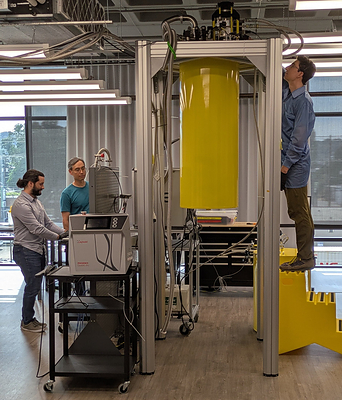
Interlune demonstrated the technology in early 2025 and was awarded an AFWERX Small Business Innovation Research (SBIR) Direct-to-Phase II contract in November 2025 to scale the technology to industrial quantities of helium. The Air Force uses helium-3 in research and development programs involving superconducting quantum computers.
"Every liter of helium produced in the world contains trace amounts of helium-3," said Rob Meyerson, co-founder and CEO of Interlune. "Cold Capture plugs into existing helium liquefaction plant infrastructure to recover that helium-3 and turn it into a valuable product."
Cold Capture serves two purposes. First, the additional helium-3 will help address the immediate demand for the isotope to cool superconducting quantum computing systems to the near-absolute-zero temperatures they require to operate. Second, Cold Capture technology will ultimately be used on the Moon to harvest industrial quantities of helium-3 from lunar soil, or regolith.
How Cold Capture Works
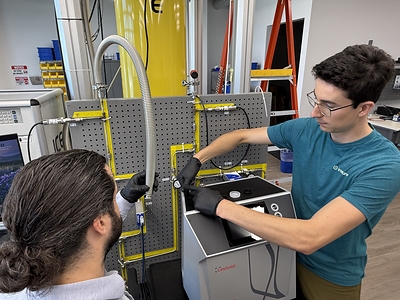
Interlune developed Cold Capture at its headquarters in Seattle. Using cryogenic distillation, the system separates helium-3 from ordinary helium at temperatures approaching absolute zero. The high purity result demonstrates that the technology can produce a helium-3 product stream suitable for commercial applications.
In 2025, the U.S. produced approximately 81 billion liters of gaseous and Grade A helium across multiple plants. If deployed across those facilities, Cold Capture could generate up to 2.5 kilograms of helium-3 annually, approximately tripling current domestic production.
"Capturing helium-3 from existing helium sounds deceptively simple," said Gary Lai, chief technology officer at Interlune. "But helium-3 and ordinary helium are almost chemically identical, making them extraordinarily difficult to separate. Cold Capture exploits subtle physical differences between the two isotopes at cryogenic temperatures to recover helium-3 in a process designed to scale."
Common Misconceptions About Terrestrial Helium-3 Availability
Currently, helium-3 is produced from aging tritium stockpiles. Tritium is a radioactive form of hydrogen that naturally decays into helium-3 over time. Most of the world's helium-3 supply comes from tritium stockpiles that have been decaying for decades. But those stockpiles are limited, and increasing tritium production is extremely capital-intensive, so contrary to some beliefs, helium-3 production cannot be expanded quickly enough to meet growing demand.
There are also recent suggestions that newly identified terrestrial helium resources could become major new sources of helium-3. In reality, helium-3 exists only in trace amounts in any terrestrial helium, regardless of location. The challenge is not finding another source of helium, but separating helium-3 efficiently from the enormous volumes of helium already being processed every year. Because Cold Capture integrates with helium liquefaction plants that aggregate helium from multiple sources, it can capture substantially more helium-3 than any single gas field could produce.
Growing Demand from Quantum Computing
Commercial demand for helium-3 is increasing as superconducting quantum computers rely on dilution refrigerators to reach temperatures within a few degrees of absolute zero. Helium-3 is one of the rarest commercially used materials on Earth, with limited global production.
In addition to funding from AFWERX, Interlune has secured nearly $500 million in legally binding helium-3 purchase agreements, primarily from quantum refrigeration companies Maybell Quantum and Bluefors. The company has also raised $23 million in venture capital and secured approximately $18 million in non-dilutive funding from the U.S. government and others.
While Cold Capture addresses today's helium-3 shortage, it also validates a critical technology for Interlune's long-term mission to commercialize natural resources from space. The same cryogenic separation principles demonstrated on Earth are intended to enable future industrial-scale production of helium-3 from lunar resources, supporting advanced computing, scientific research, and a permanent human presence beyond Earth.
About Interlune
Interlune is a privately funded space infrastructure and resources company building the industrial backbone of the lunar economy. Founded in 2021 by a team of public- and private-sector experts, the company is developing and testing industrial systems that will operate autonomously in extreme environments. These technologies will create the fundamental infrastructure to support a permanent human presence on the Moon and an in-space economy. Central to the mission is harvesting natural resources in space, starting with helium-3 and also including hydrogen, oxygen, metals, rare earth elements, and water. Interlune has secured nearly $500 million in binding helium-3 purchase agreements from government and commercial customers. The company has also raised $23 million in venture capital and secured more than $18 million in non-dilutive U.S. government research funding. Follow Interlune on LinkedIn, X, Bluesky, Facebook, and Instagram.

 View original content to download multimedia:https://www.prnewswire.com/news-releases/interlune-produces-pure-helium-3-from-domestic-helium-using-novel-cryogenic-technology-302829735.html
SOURCE Interlune

